

“Will scaling make my teeth thinner?” “Does ultrasonic cleaning scrape away my enamel?” “Why are my teeth sensitive after scaling?”
These are some of the most common concerns patients have about professional teeth cleaning.
And it’s easy to understand why.
After a cleaning, you might notice that your teeth feel different. They may feel smoother, you may experience some temporary sensitivity, or you may suddenly notice small spaces around your gumline that you hadn’t seen before.
This can lead to an understandable question:
“Did the scaling damage my teeth?”
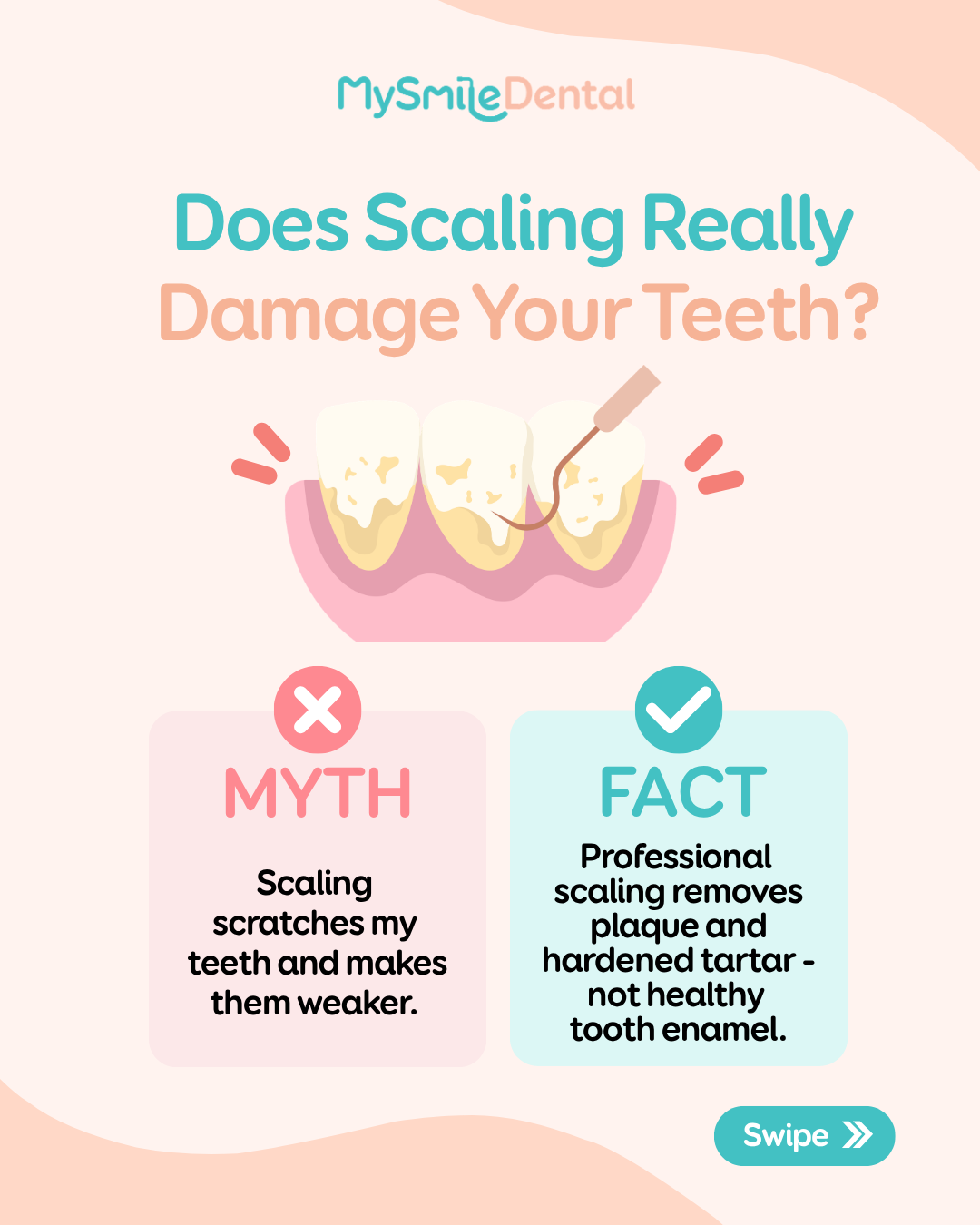
The short answer is: professional scaling is designed to remove plaque and hardened tartar—not healthy tooth enamel. 

However, there is a little more to the story. Understanding what scaling actually does, why sensitivity can occur, and what the research tells us can help separate fact from dental myth.
What Exactly Is Dental Scaling?
Plaque is a soft, sticky film containing bacteria that constantly forms on our teeth.
Regular brushing and cleaning between the teeth can remove much of this plaque. However, when plaque remains on the tooth surface, it can become mineralised and harden into dental calculus, commonly known as tartar.
Once tartar has formed, brushing alone cannot remove it effectively.
That’s where professional scaling comes in.
During a dental cleaning, your dentist or dental hygienist uses specialised instruments to remove plaque and calculus from the tooth surfaces, particularly around the gumline and, when necessary, below the gumline.
The objective is to remove these deposits while preserving the tooth structure underneath.
Research supports the role of mechanical plaque and calculus removal in periodontal care. Studies comparing hand and ultrasonic instrumentation have found that both approaches can effectively contribute to periodontal treatment, with systematic reviews generally finding comparable clinical outcomes between the techniques. PubMed
So, rather than thinking of scaling as “scraping the tooth”, it is more accurate to think of it as removing accumulated deposits from the tooth and gum environment.
Does Scaling Remove Tooth Enamel?
Professional scaling is not intended to remove healthy enamel.
The purpose of scaling is to remove plaque and calculus—not to make the tooth smaller or thinner.
A position paper from the American Academy of Periodontology reported that ultrasonic and sonic scalers can achieve results similar to hand instruments for removing plaque and calculus. It also noted that ultrasonic scalers used at medium power appeared to produce less root-surface damage than hand or sonic scalers in the evidence available at the time. PubMed
But there is an important scientific nuance.
It would be too strong to say that dental instrumentation can never produce any surface changes whatsoever.
A 2026 systematic review of laboratory studies examined the effects of hand instruments, ultrasonic scalers and air-polishing devices on dental hard tissues. The researchers found that instrumentation can produce varying degrees of material loss and surface roughness depending on the instrument and conditions used. However, the authors emphasised that much of this evidence comes from in-vitro laboratory studies, and the clinical significance of these microscopic changes remains uncertain. PubMed
Another recent review similarly found that periodontal instrumentation can alter enamel and cementum surfaces to varying degrees, depending on instrumentation parameters, while noting that the available evidence is predominantly laboratory-based. PubMed
So what does this mean for patients?
It means that the popular claim:
“Scaling scrapes away your enamel and damages your teeth.”
is an oversimplification of the evidence.
Professional scaling is a clinically established procedure intended to remove harmful deposits such as calculus. The instruments and technique should be selected and used appropriately according to the patient’s dental condition.
Why Do My Teeth Feel Sensitive After Scaling?
This is probably one of the biggest reasons people believe scaling has damaged their teeth.
After cleaning, some patients experience temporary sensitivity, especially to cold drinks or foods.
Interestingly, this phenomenon is well documented in the scientific literature.
A systematic review published in PubMed found that root sensitivity can increase following periodontal therapy. In one review, sensitivity was reported to increase during the first one to three weeks after treatment and subsequently decrease. PubMed
Another systematic review found that dentine/root sensitivity following nonsurgical periodontal treatment was often highest shortly after treatment and generally decreased over time. The authors described the discomfort as generally mild to moderate and transient, although the prevalence varied between studies. PubMed
So why does this happen?
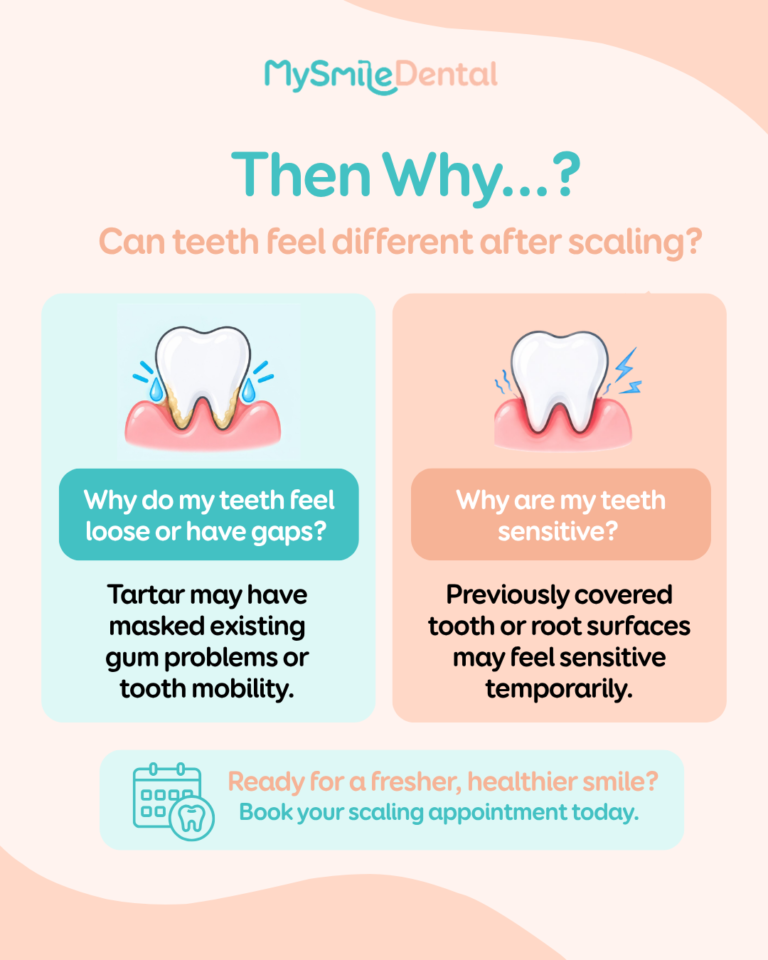
If tartar has accumulated around the gumline, it may have been covering parts of the tooth or root surface.
Once the tartar is removed, those surfaces are exposed to the oral environment again.
If the gums have also been inflamed, treatment may reduce that inflammation and change the way the gumline looks and feels.
The result can be a temporary increase in sensitivity.
Sensitivity after scaling does not automatically mean your enamel has been damaged.
“I Have Gaps After Scaling!” — Did the Cleaning Create Them?
This is another common concern.
Some patients look in the mirror after a cleaning and notice spaces around their teeth that they hadn’t noticed before.
Their first thought may be:
“The dentist created these gaps!”
Usually, that’s not what happened.
If there was significant tartar buildup, the calculus may have been occupying or covering spaces around the teeth.
In addition, inflamed gums can become swollen. When the inflammation is reduced after professional cleaning and improved oral hygiene, the gum tissue may look less swollen.
As a result, spaces that were previously hidden can become more noticeable.
In patients with periodontal disease, there may also be pre-existing gum recession or loss of supporting bone.
So the cleaning may have revealed an existing condition rather than created a new one.
This is one reason a dental examination is important if you are concerned about changes in the appearance of your teeth or gums.
Dr Tan Jian Xiong: “The Goal of Scaling Is to Remove Calculus”
Dr Tan Jian Xiong, Clinical Director, explains:
“One of the most common misconceptions we encounter is that scaling removes the tooth itself. The purpose of scaling is to remove plaque and calculus that have accumulated on the teeth. After treatment, some patients may notice sensitivity or changes around the gumline, but these changes do not necessarily mean that the tooth has been damaged.”
This distinction is important.
The aim of professional cleaning is not to make your teeth smaller. It is to remove deposits that cannot be effectively removed through normal brushing alone.
Research comparing hand and ultrasonic instrumentation has found that both approaches can provide periodontal benefits, with systematic reviews showing broadly comparable outcomes in several clinical measures. PubMed
Dr Ng Kay Eng: “Sometimes Scaling Reveals What Was Already There”
Dr Ng Kay Eng, Managing Director, adds:
“Patients sometimes become concerned when they see spaces around their teeth after a cleaning. In many cases, these spaces were already present but were hidden by tartar or swollen gum tissue. Removing the tartar allows us to see the teeth and gums more clearly and, importantly, gives the gums an opportunity to return to a healthier state.”
This is an important part of managing expectations.
A dental cleaning doesn’t necessarily make the mouth look exactly the same as it did when tartar was present.
In fact, healthy gums may look different from inflamed, swollen gums, and clean teeth may reveal areas that were previously obscured by calculus.
Is Ultrasonic Scaling Safe?
Ultrasonic scalers are widely used in modern dentistry because they can efficiently disrupt and remove calculus and bacterial deposits.
Research has found that ultrasonic and sonic instrumentation can achieve periodontal treatment results comparable to hand instrumentation in many clinical situations. A 2020 systematic review and meta-analysis of 18 studies found significant improvement in at least one periodontal parameter with both approaches, without significant differences in clinical attachment-level gain at three and six months. PubMed
However, technique matters.
The instrument’s power, tip selection, movement, duration of contact and the type of surface being treated can all influence the result.
This is particularly important when treating exposed root surfaces, restorations, crowns, bridges and implants.
The scientific literature therefore supports a more nuanced message:
Ultrasonic scaling is an established periodontal treatment, but it should be performed appropriately and tailored to the patient’s individual needs.
Why Removing Tartar Matters
If tartar is left in place because someone is worried about scaling, that doesn’t necessarily protect the teeth.
Calculus creates a rough surface where plaque can accumulate more readily.
Persistent plaque and inflammation can contribute to gum disease and periodontal problems.
Scaling and root-surface debridement are therefore important components of periodontal treatment when indicated.
A systematic review of nonsurgical periodontal treatment supports subgingival instrumentation as a fundamental approach to managing periodontitis. PubMed
In other words, avoiding professional cleaning because of the fear that “scaling damages teeth” can mean allowing a genuine oral-health problem to remain untreated.
Does Everyone Need the Same Type of Scaling?
No.
Not every patient has the same amount of plaque, calculus or gum disease.
Your dentist may consider factors such as:
- The amount of tartar present
- Where the tartar is located
- Gum bleeding and inflammation
- Periodontal pocket depth
- Gum recession
- Existing tooth sensitivity
- Crowns, bridges or other restorations
- Dental implants
- Your overall periodontal health
A simple preventive cleaning is not the same as periodontal treatment involving deeper deposits.
This is why professional assessment matters.
What Can You Expect After Scaling?
After a routine cleaning, your teeth may feel noticeably smoother and cleaner.
You may also experience some temporary changes.
 Smoother teeth
Tartar and plaque deposits have been removed, leaving the tooth surfaces feeling cleaner.
 Temporary sensitivity
Some patients experience sensitivity to cold after periodontal treatment. Research suggests this usually decreases with time. PubMed
More visible spaces around the gumline
Areas previously covered by tartar or affected by swollen gum tissue may become more noticeable after cleaning.
 Healthier-looking gums
As inflammation improves, the appearance of the gum tissue can change.
If you experience severe or persistent pain, significant swelling, loose teeth or other concerning symptoms, however, speak to your dentist rather than assuming the symptoms are simply a normal reaction to cleaning.
The Bottom Line: Does Scaling Damage Your Teeth?
Professional scaling is designed to remove plaque and hardened tartar—not healthy tooth enamel.
The evidence does show that periodontal instruments can cause microscopic surface changes under certain experimental conditions, particularly on root surfaces. However, much of this evidence comes from laboratory studies, and the clinical significance of these changes is not yet clear. PubMed
At the same time, temporary sensitivity after periodontal treatment is a recognised clinical phenomenon and generally tends to decrease over time. PubMed
So if you’ve been avoiding your dental cleaning because you’ve heard that “scaling will damage your teeth,” don’t let this common myth stop you from looking after your oral health.
Your dentist can assess your individual condition, explain what type of cleaning you need, and make sure the procedure is carried out appropriately.
And if you’re nervous?
Tell your dental team.
You deserve to understand what is happening and feel comfortable asking questions about your treatment.
Ready for your next cleaning?
Whether you’re concerned about tartar, bleeding gums, sensitivity or simply haven’t had a dental check-up in a while, our friendly dental team is here to help.
Book a consultation and let Dr Tan Jian Xiong, Dr Ng Kay Eng and our dental team guide you towards healthier teeth and gums—comfortably, carefully and based on evidence.
Selected PubMed Evidence
- Root sensitivity following periodontal therapy — systematic review: sensitivity can increase after periodontal therapy and generally decreases after the initial weeks. PubMed
- Tooth hypersensitivity following periodontal therapy — systematic review: postoperative sensitivity is commonly reported and is generally transient. PubMed
- American Academy of Periodontology position paper: ultrasonic/sonic scalers can effectively remove plaque and calculus; appropriate ultrasonic use has demonstrated favourable root-surface effects compared with some instrumentation approaches. PubMed
- 2020 systematic review/meta-analysis: hand and sonic/ultrasonic instrumentation produced broadly similar periodontal treatment outcomes across the included studies. PubMed
- 2026 systematic review: mechanical instrumentation can produce hard-tissue surface changes in laboratory studies, but the clinical significance of these findings remains uncertain. PubMed
- 2026 narrative review: surface alterations vary according to instrumentation parameters, with predominantly in-vitro evidence limiting conclusions about long-term clinical effects.
