
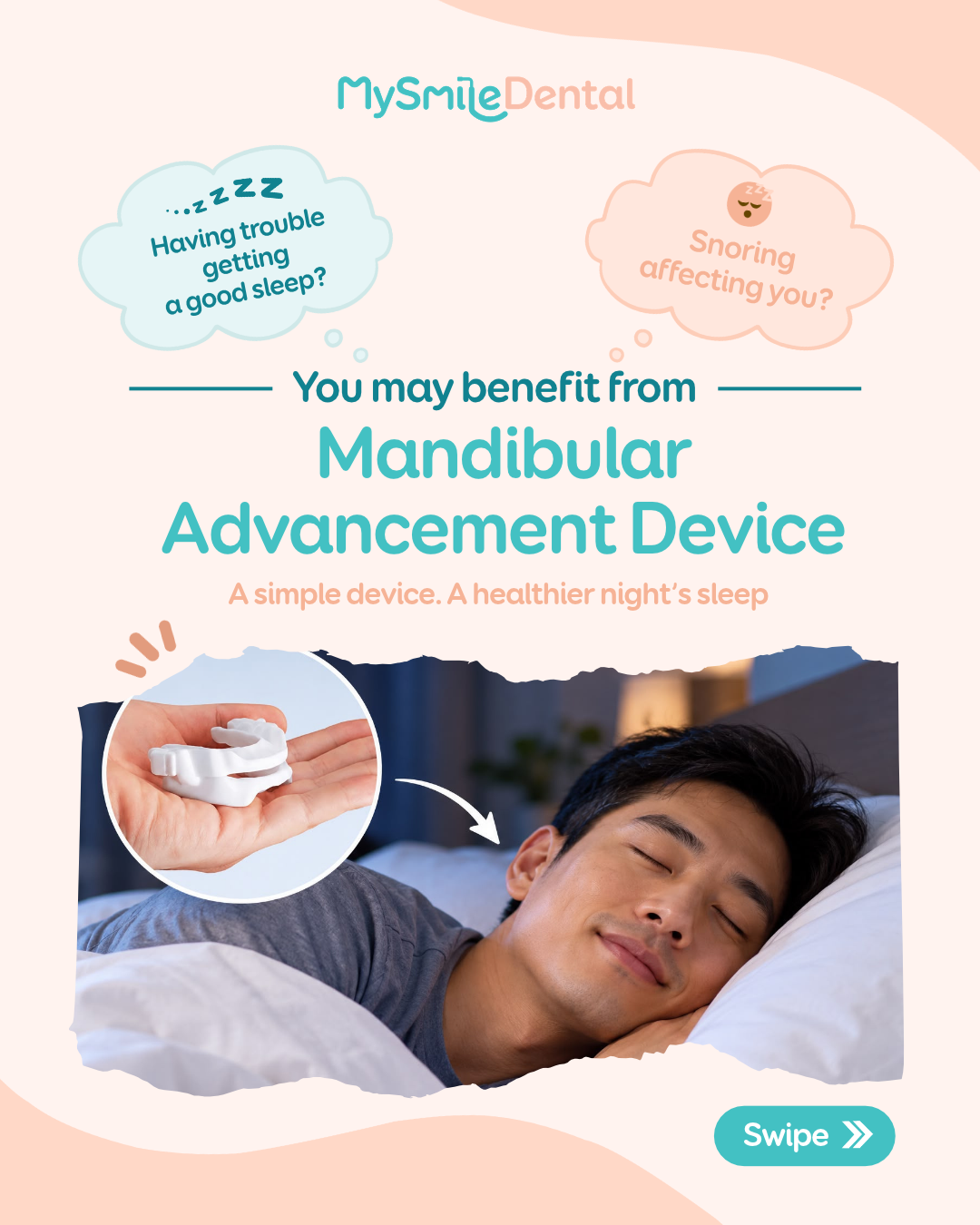
Struggling with snoring, poor sleep or daytime tiredness? Discover how a custom-fitted mandibular advancement device (MAD) may help you breathe better and sleep more comfortably.
A good night’s sleep is essential for your physical health, mental well-being and daily performance. However, frequent snoring and obstructive sleep apnoea (OSA) can interrupt your sleep, sometimes without you even realising it.
At MySmile Dental Singapore, we offer custom-fitted mandibular advancement devices as a non-surgical treatment option for suitable patients with snoring or obstructive sleep apnoea.
More importantly, MAD therapy is supported by scientific research and recognised clinical guidelines, making it an established option in dental sleep medicine.
What Is a Mandibular Advancement Device (MAD)?
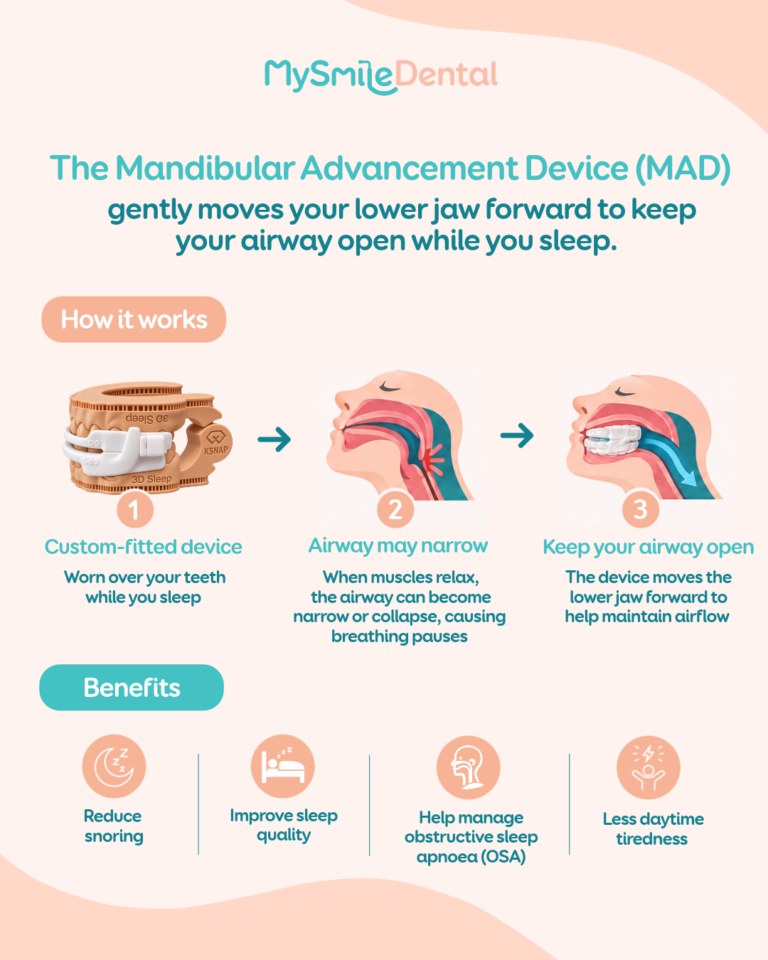
A mandibular advancement device, also known as a mandibular advancement splint or oral appliance for sleep apnoea, is a specially designed dental appliance worn over the upper and lower teeth during sleep.
The device gently positions the lower jaw forward, helping to maintain a more open airway and reduce the likelihood of obstruction.
Unlike ordinary nightguards, which are primarily designed to protect teeth, MADs are specifically designed to improve airflow during sleep.
How Does a MAD Work?
When we sleep, the muscles supporting our tongue and throat relax. For some individuals, this causes the airway to narrow or collapse.
This can result in:
Snoring: Vibration of soft tissues as air passes through a narrowed airway.
Obstructive sleep apnoea: Repeated episodes of partial or complete airway obstruction, causing breathing interruptions and disrupted sleep.
Daytime fatigue: Poor sleep quality contributing to tiredness and reduced concentration.
A MAD works by gently advancing the lower jaw, bringing the tongue and surrounding tissues forward to help keep the airway open.
Expert Insight — Dr Tan Jian Xiong, MySmile Dental
“Many people think snoring is simply a noisy sleeping habit. However, persistent snoring can sometimes be a warning sign of an underlying breathing problem during sleep. A mandibular advancement device works by repositioning the lower jaw to help maintain an open airway, allowing suitable patients to breathe more comfortably at night.”
Is a Mandibular Advancement Device Scientifically Proven to Work?
Yes. Mandibular advancement devices are supported by clinical trials, systematic reviews and professional sleep medicine guidelines.
Research has demonstrated benefits in reducing snoring, improving obstructive sleep apnoea severity and reducing subjective daytime sleepiness in selected patients.
1. Scientific Evidence: MADs Can Reduce Snoring and Sleep Apnoea
A major clinical practice guideline published in the Journal of Clinical Sleep Medicine in 2015 reviewed evidence on oral appliance therapy for snoring and OSA.
Developed by the American Academy of Sleep Medicine (AASM) and the American Academy of Dental Sleep Medicine (AADSM), the guideline supports oral appliances for adults with primary snoring and recommends considering them for OSA patients who cannot tolerate CPAP or prefer an alternative.
The guideline also favours custom-made, adjustable oral appliances over non-custom devices.
What does this mean for patients?
A properly prescribed and fitted MAD is not simply an anti-snoring gadget. It is an established treatment option supported by professional sleep medicine guidelines.
Research reference: Ramar K, et al. (2015). Clinical Practice Guideline for the Treatment of Obstructive Sleep Apnea and Snoring with Oral Appliance Therapy. Journal of Clinical Sleep Medicine.
2. Scientific Evidence: MADs May Improve Blood Pressure
Obstructive sleep apnoea is associated with cardiovascular health concerns, including high blood pressure.
A systematic review and meta-analysis published in JAMA in 2015 analysed 51 randomised clinical trials involving 4,888 participants.
Researchers found that mandibular advancement devices were associated with reductions in blood pressure compared with inactive controls.
Average reductions associated with MAD treatment:
Systolic blood pressure: approximately 2.1 mmHg
Diastolic blood pressure: approximately 1.9 mmHg
The analysis did not identify a statistically significant difference between MADs and CPAP in their association with blood pressure reduction.
Although these average improvements were modest, they suggest that oral appliance therapy may offer benefits beyond reducing snoring.
However, MADs should not be regarded as a replacement for prescribed blood pressure treatment, and improvements in blood pressure do not necessarily establish a reduction in heart attacks or strokes.
Research reference: Bratton DJ, et al. (2015). CPAP vs Mandibular Advancement Devices and Blood Pressure in Patients With Obstructive Sleep Apnea: A Systematic Review and Meta-analysis. JAMA.
Expert Insight — Dr Tan Jian Xiong, MySmile Dental
“Snoring and sleep apnoea are not just about disturbing your partner’s sleep. Untreated obstructive sleep apnoea can have wider implications for health and daytime functioning. Research suggests that mandibular advancement devices can improve breathing disturbances during sleep and may offer additional health benefits for suitable patients.”
Benefits of a Mandibular Advancement Device
Reduce Snoring
By positioning the lower jaw forward, a MAD helps reduce upper airway narrowing and tissue vibration, potentially resulting in quieter sleep.
This can benefit both the person who snores and their sleeping partner.
Improve Sleep Quality
Breathing disturbances during sleep can lead to repeated arousals and fragmented sleep.
Effective MAD treatment may reduce these disturbances and improve how refreshed patients feel after waking.
Help Manage Obstructive Sleep Apnoea
MADs can reduce the frequency of breathing interruptions in selected OSA patients.
Treatment effectiveness is usually assessed using the apnoea-hypopnoea index (AHI), which measures the average number of apnoea and hypopnoea events per hour of sleep.
A reduction in AHI indicates an improvement in sleep-related breathing disturbances.
Reduce Daytime Sleepiness
Research reviewed in the AASM/AADSM guideline found that custom, adjustable oral appliances can improve subjective daytime sleepiness.
For patients who respond well, this may translate into better daytime alertness and quality of life.
Convenient and Travel-Friendly
MADs are compact and do not require electricity, tubing or a face mask.
For patients who travel frequently or have difficulty tolerating CPAP, a dental appliance may be a convenient alternative.
MAD vs CPAP: Which Treatment Is Better?
Continuous positive airway pressure (CPAP) is a highly effective treatment for obstructive sleep apnoea.
It works by delivering pressurised air through a mask to prevent the upper airway from collapsing.
A mandibular advancement device works differently, mechanically repositioning the lower jaw to improve airway patency.
| Feature | MAD | CPAP |
|---|---|---|
| Treatment mechanism | Advances lower jaw | Uses pressurised air |
| Appliance | Custom dental device | Mask and machine |
| Portability | Compact | Requires more equipment |
| Electricity | Not required | Usually required |
| Reduction in AHI | Effective in selected patients | Generally greater |
| Patient preference | May be preferred for convenience | May be preferred for stronger physiological control |
| Monitoring | Dental and sleep medicine follow-up | Sleep medicine follow-up |
Clinical guidelines recognise MADs as an appropriate alternative for selected patients who cannot tolerate CPAP or prefer another treatment.
Expert Insight — Dr Tan Jian Xiong, MySmile Dental
“CPAP remains a very effective treatment for obstructive sleep apnoea, particularly in more severe cases. However, some patients find it difficult to use consistently. A custom-fitted mandibular advancement device may offer a more comfortable and convenient alternative for selected patients. The important thing is choosing a treatment that is clinically appropriate and effective for the individual.”
Why Choose a Custom-Fitted Mandibular Advancement Device?
Although over-the-counter anti-snoring mouthguards are available, they may not provide the same fit, adjustability or professional oversight as custom-made devices.
A custom-fitted MAD offers several potential advantages:
Personalised fit based on your dental anatomy
Adjustable lower jaw advancement
Professional evaluation of your teeth, gums and jaw joints
Ongoing monitoring of treatment comfort and dental side effects
Opportunities to optimise the appliance based on treatment response
The AASM/AADSM guideline recommends custom, titratable appliances over non-custom devices when oral appliance therapy is prescribed for OSA.
Regular follow-up is also important because prolonged MAD use may cause jaw discomfort, tooth tenderness or changes in the bite.
Expert Insight — Dr Tan Jian Xiong, MySmile Dental
“A mandibular advancement device is not a one-size-fits-all solution. The position of the lower jaw needs to be carefully adjusted to balance airway improvement with comfort. A proper dental assessment and regular follow-up are important to minimise unwanted effects on the teeth, bite and jaw joints.”
Who Is Suitable for Mandibular Advancement Device Treatment?
You may benefit from an assessment for MAD therapy if you:
Snore frequently or loudly
Have been diagnosed with obstructive sleep apnoea
Experience excessive daytime sleepiness
Find CPAP uncomfortable or difficult to tolerate
Prefer a non-surgical treatment option
Have suitable dental and jaw conditions for an oral appliance
However, not every patient is suitable for MAD treatment.
Patients with untreated dental disease, insufficient tooth support, certain jaw joint problems or significant limitations in jaw movement may require additional assessment.
Importantly, patients with suspected OSA should undergo appropriate medical evaluation and sleep testing before treatment.
What to Expect During MAD Treatment at MySmile Dental
Step 1: Consultation and Dental Assessment
Our dentist evaluates your teeth, gums, bite, jaw joints and suitability for oral appliance therapy. Patients with suspected OSA may require assessment by a sleep physician.
Step 2: Custom Appliance Fabrication
Dental impressions or digital scans are used to fabricate an appliance that fits your teeth.
Step 3: Appliance Fitting and Adjustment
Your dentist checks the appliance fit and comfort. Jaw advancement may be adjusted gradually to achieve a suitable balance between effectiveness and comfort.
Step 4: Follow-Up and Monitoring
Regular reviews help monitor dental health, appliance fit and possible changes to your bite.
For OSA patients, follow-up sleep testing is recommended to objectively assess treatment effectiveness.
Frequently Asked Questions
Can a mandibular advancement device stop snoring completely?
A MAD can significantly reduce snoring in suitable patients, but complete elimination is not guaranteed. The outcome depends on individual anatomy and the underlying cause of snoring.
Is a mandibular advancement device effective for severe sleep apnoea?
Some patients with severe OSA may benefit from MAD treatment, particularly when CPAP cannot be tolerated. However, CPAP generally provides greater reductions in breathing events, and severe cases require careful medical supervision.
Does a MAD permanently cure sleep apnoea?
No. A MAD generally controls breathing disturbances while it is being worn. It does not permanently eliminate the underlying tendency for airway obstruction.
Can a MAD cause jaw pain or change my bite?
Some patients experience temporary jaw discomfort or tooth tenderness. Long-term use may also cause changes in tooth position or bite alignment. Professional monitoring helps identify and manage these effects.
Is a mandibular advancement device suitable for everyone who snores?
No. Snoring can be associated with obstructive sleep apnoea, so appropriate medical assessment is important before treating it as simple snoring.
Explore Mandibular Advancement Device Treatment at MySmile Dental Singapore
Snoring and sleep apnoea can affect your sleep quality, energy levels and overall well-being.
A custom-fitted mandibular advancement device offers a scientifically supported, non-surgical option for selected patients who want to reduce snoring or manage obstructive sleep apnoea.
At MySmile Dental Singapore, our dentists can assess your dental suitability for MAD therapy and discuss appropriate treatment options.
Looking for snoring treatment or a mandibular advancement device in Singapore?
Contact MySmile Dental to arrange a consultation and find out whether MAD treatment may be suitable for you.
Book Your Consultation with MySmile Dental Today
Scientific References
Ramar K, Dort LC, Katz SG, et al. (2015). Clinical Practice Guideline for the Treatment of Obstructive Sleep Apnea and Snoring with Oral Appliance Therapy: An Update for 2015. Journal of Clinical Sleep Medicine, 11(7), 773–827. PubMed
Bratton DJ, Gaisl T, Wons AM, Kohler M. (2015). CPAP vs Mandibular Advancement Devices and Blood Pressure in Patients With Obstructive Sleep Apnea: A Systematic Review and Meta-analysis. JAMA, 314(21), 2280–2293. PubMed
Medical disclaimer: This article is intended for general education and does not replace individual medical advice. Diagnosis and treatment of obstructive sleep apnoea require appropriate medical assessment. Treatment results vary between individuals.
